
Keep the evidence in view.
I build tools that help specialists find the material worth a closer look: a clause outside the playbook, a missing research record, or a document that needs restricted handling. Each finding should take you back to the evidence.
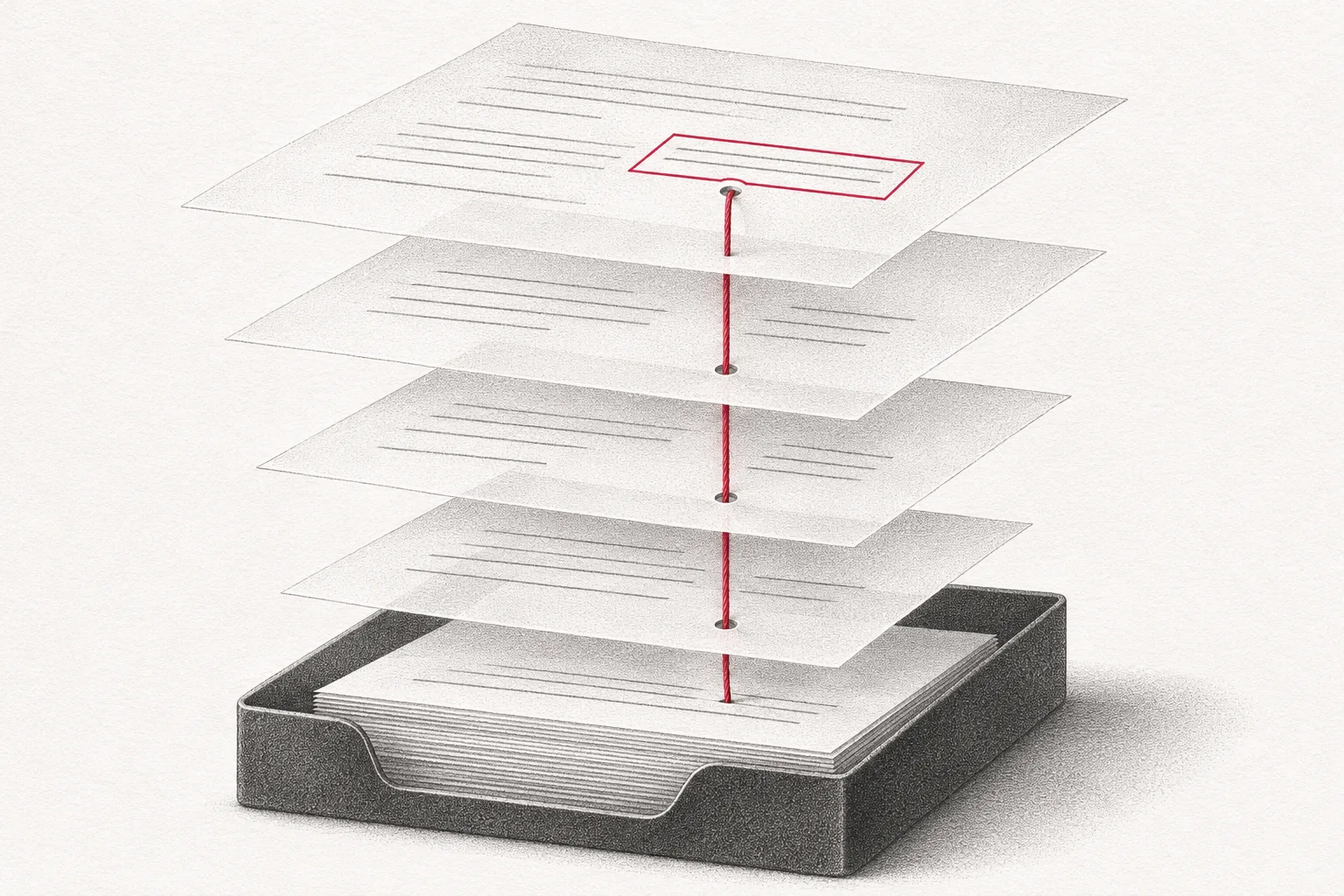
Your experts define the rules. We make them testable.
My background includes research infrastructure, model experiments, and data-quality systems. I bring that engineering to review workflows: clear definitions, reproducible checks, and a record of what a person verified.
- Legal playbook checks
- Classify clauses, extract obligations, and flag potential departures from an approved review playbook, with the original passage attached.
- R&D evidence packs
- Check research records against an agreed checklist: dataset provenance, approvals, experiment records, model versions, and missing supporting material.
- Sensitive document handling
- Suggest document categories and flag potentially sensitive passages for review before material is shared or released.
A review pack you can follow back to the source.
An R&D team is preparing a model release. The results look promising, but the reviewer also needs to see which dataset, approvals, code, and model version support the result. An agent can gather the material while a specialist model classifies or extracts what the checks need.
Example engagement · Illustrative workflow, not a client result or live model demonstration.
Input
The agreed checklist and authorised access to the project’s records.
System task
Assemble source-linked evidence; flag missing records or potential inconsistencies.
Human decision
The responsible expert reviews the evidence and decides whether the requirements have been met.
What we’d measure.
- Traceable findings
- Check that each finding points to the correct passage or record, and the exact source version.
- Missing evidence
- Try incomplete packs, conflicting records, and unfamiliar documents. A missing source must remain visibly missing.
- Review boundaries
- Test permissions, separation between matters or projects, and which decisions require an authorised reviewer.
These tools support legal and R&D compliance review. They do not certify compliance or replace legal, clinical, or governance judgement. Local hosting is a deployment choice, not a compliance guarantee.
Research infrastructure is part of my background.
I was Technical Lead and Solutions Architect on EcoCommons. Building for researchers taught me to treat provenance, reproducibility, and usable workflows as part of the product.
Read the EcoCommons case studyStart with one useful test.
Bring one task, a few representative examples, and the constraints that matter. We’ll agree what to compare before starting.
Model feasibility sprint
A$5,500
One task, a baseline, and one alternative. You get the comparison, the important failure cases, and a recommendation on what to build or keep.
Need an initial second opinion? The A$1,250 production review is a smaller place to start. Larger builds and production integration are scoped separately.
A few useful questions.
Does this always need fine-tuning?
No. Retrieval, rules, and an existing model may be enough. Training earns its place when a comparison shows a useful improvement on a recurring task.
Can it work in our own environment?
We can scope local or private deployment around your access, retention, and infrastructure requirements. Your security and governance team helps define the requirements; the build is evaluated against them.
Bring the awkward examples.
Tell me about the task and where the current approach falls short. A description is plenty for the first conversation; we’ll agree how to share any sensitive material.